
I’ve now written two pieces on the economics of AI datacenters (Piece 1, Piece 2). Nothing shakes me from my view that these are deeply negative ROIC investments. Yet, hyperscalers have continued to plow ahead and build them anyway.
First, they’ve used up most of their annual cash flow, then they’ve taken on debt to fund them, and now Alphabet (GOOG) has even resorted to its first major equity issuance since 2004 (with Meta reportedly considering one as well now). Despite their desperation to build datacenters, I haven’t seen a single financial model that shows one with a positive ROIC. It’s sort of surreal to watch, as any sane human would long ago have reversed course. But no, these guys are simply in a never-ending race to build datacenters.
The only recent historical comparable that I can think of is last decade’s shale patch. While I’m not involved in datacenters, I did have a unique window into shale through my frequent calls to shale CEOs, pleading with them to stop drilling wells with negative ROICs at then-current strip prices. I see a lot of the datacenter mentality, through the lens of those calls. Let me combine a few dozen of those shale oil CEO calls, and build you a composite collage of the typical conversation.
Me: By my math, drilling these wells at $55 oil has a negative ROIC. Do you have some different math that disproves mine??
Him: Mr. Kuppy, I’m an oilman. I’m not a numbers man. If those are your numbers, I cannot refute them.
Me: So, then why are you drilling wells with a negative ROIC??
Him: I’m an oil man. That’s just what I do. I drill wells, as long as someone will fund them.
Me: Don’t you realize that you’re drilling yourself to death. You’re destroying capital. If you stopped today, you could create real value for shareholders. If you keep going, you’ll go bust.
Him: I promised the shareholders that we’d have production growth, and I refuse to break my promise to them.
Me: Your stock is down 90% in the past 2 years. The market hates your production growth plans.
Him: …But we don’t want to upset our lenders.
Me: You’re borrowing at 18% with warrants. The lenders are telling you that you’re about to be cut off.
Him: Yeah, that debt, it really is pretty expensive… But, if I stop drilling, all my oil friends will think I’m a loser.
Me: Who cares?? They’re all about to go bankrupt. Why don’t you stop drilling, use the cashflow to pay down expensive debt, and then put yourself into a better position to buy up you competitors in bankruptcy, as they drill themselves to death??
Him: …uhhh…hmmmm…. Mr. Kuppy, you just don’t understand oilmen. We drill. If we have money we drill. If we don’t have money, we still drill. We always find a way to keep drilling. I don’t care if these things have negative ROIC. I’ve told you, I’m not a numbers man, I’m an oil man!! God put me on this earth to drill wells!! Unless you’re about to give me money to drill a well, I think we’re done here… <Hangs Up Phone>
Trust me, I begged. I pleaded. I thought that if I could just get one of these guys to stop drilling, the stock would scream higher. They’d pay down some debt, and then consolidate whole basins as their stocks would trade up from 2x EBITDA to 4x EBITDA. Those drilling locations would be priceless today. It would be an absolute home run. Instead, they were drilled at a $50s strip, and a negative ROIC. It was the most incredulous thing to watch. CEOs, some of whom lost hundreds of millions, just kept drilling, despite knowing that the economics were insane. They simply refused to be the first to break ranks. They preferred to go broke, rather than stop drilling.
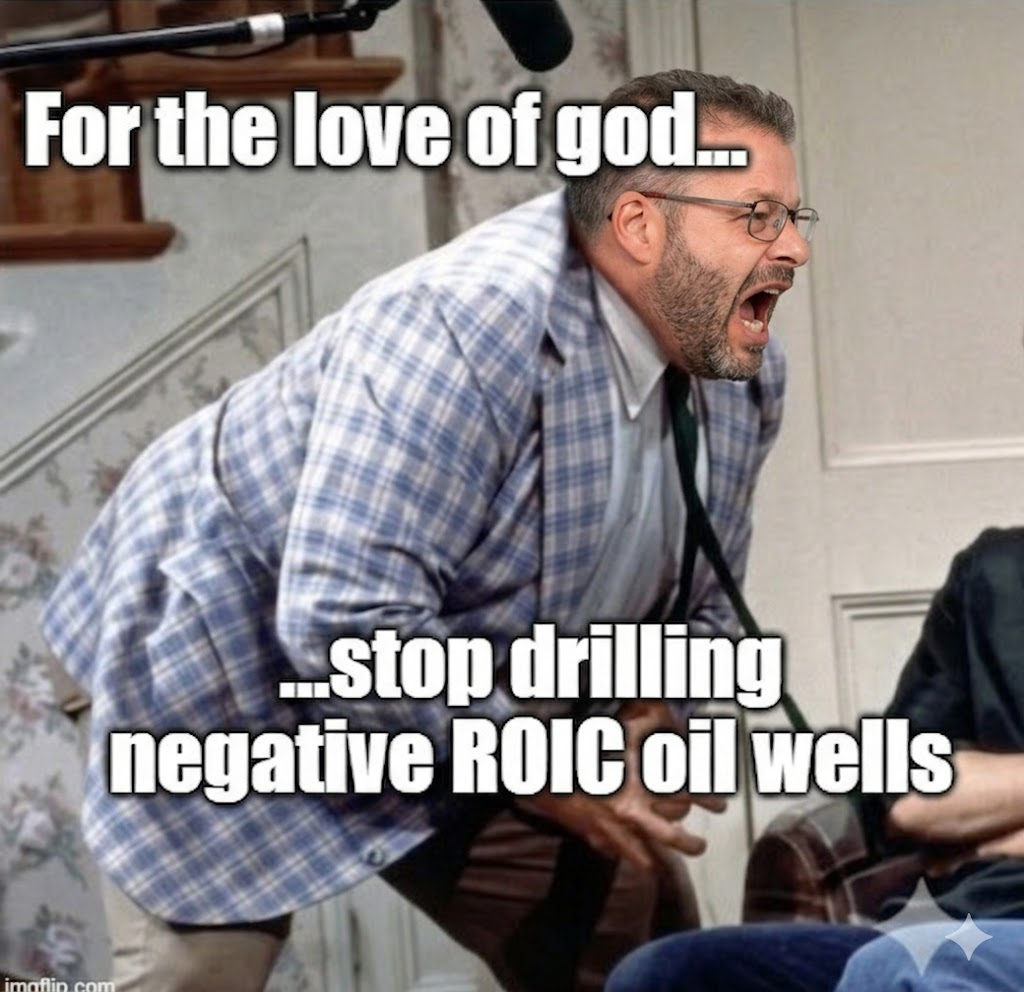
They all went broke or were acquired for pennies on the dollar. I literally never convinced a single one of them to stop drilling. Instead, during COVID, when oil briefly went negative, the market pulled the plug on these companies. They couldn’t access any more debt, nor equity. The market refused to let them drill another well. It was the market that finally ended their drilling spree.
However, the market tried it the nice way first. The equity markets cut them off first, as these things traded down to 2x EBITDA, then the lending markets froze them out. They could have reversed course. Instead, they simply kept going. At any moment in time, they could have stopped, but they refused.
I bring this all up as the hyperscalers seem obsessed with building more datacenters, and have now begun to outrun their own resources. I’m not saying that this is the end of the datacenter buildout. Instead, I’m saying that this is an interesting signpost along the way.
I remember that there was a time in the shale patch where investors genuinely wanted companies to grow production. They wanted to see wells drilled as each vintage seemed to have better economics as the technology improved. I remember these things trading at absolutely insane valuations. I remember companies that were rewarded for bragging that they had enough land to drill billions worth of new wells. These were considered growth names, until they weren’t. Eventually, the math caught up with them, and no one would reverse course. They just kept going—partly because they had spending commitments that they couldn’t get out of, and partly because they needed EBITDA growth to keep the banks at bay. Mostly, they just believed that if they could somehow produce more oil, it would solve things.
We’re still in the happy phase where investors want to see more datacenters. Which is somewhat odd, because for two decades, these hyperscalers were valuable precisely because they were asset-light. Now, they’re increasingly becoming asset-heavy. At some point investors who have grown accustomed to buybacks, will grow frustrated by capital issuances. Then, they’ll get disgusted by the datacenter buildout. They’ll beg, they’ll plead, and eventually they’ll sell the shares down in complete frustration. Yet, still, these companies will keep going. Do you remember how much pain Zuck had to take on the Metaverse before he finally canned it?? The stock had to completely detonate for him to give up.

Maybe these tech names won’t go to 2x EBITDA like shale names, but if they have the same terrible economics (at scale, with huge electricity purchase commitments), maybe they will*. This is a process. I don’t think we’re at the end of the buildout—not yet. These guys still have a lot of rope left to access cashflow, balance sheet capital and the equity markets. However, the pivot from buybacks to equity issuances is an intriguing signpost along the way. I think we’re finally at the point where investors start to get disgusted by the change in business plan. Then the re-rating starts.
Much like my oilmen, I suspect that the tech bros will just push ahead anyway, despite the pleas to stop. They’re chasing AGI, or creating a new god, or whatever it is that tech bros dream about—just like oilmen dream about drilling wells. It’s going to take a lot of pain to talk them out of this.
I still remember those calls in the back half of the 2010s. I was really in disbelief as guys bankrupted themselves—they even took pride in it. In the back half of the 2020s, tech investors will get to experience a similar emotion.
As far as I’m concerned, datacenters are the new shale…
*All valuation multiples cited are hypothetical or illustrative historical comparisons, not price targets or forecasts. Actual results may differ materially.

When The Levee Breaks…